
If you’re looking for perfection in a novel that inhabits a labyrinth of love, loss, and separation, then “Divisadero” is not for you. To reap the many rewards of Ondaatje’s poetic prose – formed into a triptych of stories joined only by the most gossamer of narrative threads – a reader requires two tools rarely needed in this age of dialogue-driven fast-reads: patience and forgiveness.
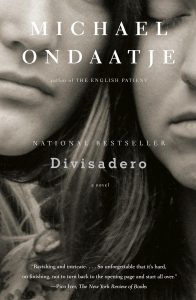
The core characters – so chosen by their dominance of “Divisadero’s” first half – are Anna, Claire, and Coop, a ranching family formed by chance: the death of Anna’s mother in childbirth; her father’s absconding of Claire from the hospital nursery following her mother’s identical fate; and the rescue of Coop as a toddler after a hired hand killed his parents on a neighboring farm.
The children, living in idyllic rural isolation amid the rolling hills of Northern California, mature with the intimacy of inseparable siblings. As they grow, the cultural revolution of the Seventies shapes them less than the freedoms their taciturn father grants – and the limitations he imposes.
One day, an act of young love interrupted by an eruption of brutality fragments the family. The shards scatter across time and geography. As adults, living far from each other, Anna an academic, Claire a public defender, and Coop a professional cardplayer, never fully escape the familial rupture. They bend under baggage laden with grief.
Is “Divisadero” too heavy for those of lighter hearts? I think not. The characters are rich and deep. The language is memorable. The emotions real. Ondaatje does not shy from violence. What negatives there are – and there are few – result from Ondaatje’s self-indulgence, displayed as occasional wandering side passages, especially those that allow a dead French poet whose work Anna is studying to wax at length about his own decision to settle for less in life.
In short, “Divisadero” delivers more than it exacts.
I’ll end with an ending. Here is the conclusion of the New York Times review of “Divisadero,” which says in one paragraph that which I’ve devoted considerably more to:
“It’s no good wishing a novel were different than it is; but the brokenness of Ondaatje’s tale can be frustrating. Still: ‘Divisadero.’ What did we expect? It’s possible to believe that Ondaatje’s method of mosaic more accurately reflects the untidy turns life tends to take; his characters make unfortunate decisions but then, so do we. There is something endearingly human about this book, for all its art: who can’t forgive a hopeless romantic?”