
I liked this sometimes sappy, sometimes wise, mostly humorous story more than others who have commented on it. Here are three reasons why:
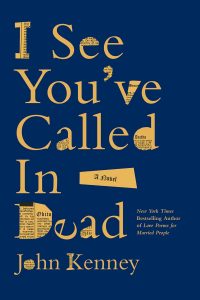
- Bud Stanley, the main character, works as an obituary writer in the newsroom of a major news service, and, as a former wretch of that profession, I am a sucker for such ink-stained ambience and its accompanying cast of wise-cracking (but caring) characters.
- The setting is New York, and Kenney (a longtime contributor to “The New Yorker”) captures its zeitgeist with precision and gusto. (Describing parents in Brooklyn: “They were uniformly attractive men and women. They didn’t look like regular people. They looked better, like people from New York. The men, youthful in appearance, possibly having squeezed in a quick 10K that morning, had superb hair.” There’s no better place than NYC to practice instant anthropology.
- This sentence: “I wonder why there isn’t a rule that says that you cannot watch your mother die.” Explanation to come.
The story is simple: Bud – middle-aged, busted marriage, so-so career – is stuck waist-high in a depressive wallow. One night, after a blind-date dies on the vine when the woman shows up with her ex-boyfriend, Bud returns to his apartment, gets drunk, writes his own obituary, and accidentally sends it out on the news wire. The obit reads:
“Bud Stanley, 44, former Mr. Universe, failed porn star, and mediocre obituary writer, is dead.” It adds, among other inventions, that Bud was a one of the original Pips for Gladys Knight.
As expected, Bud loses his job. As unexpected (I suppose), Bud finds his lost life: enduring friendship with a wheelchair-bound bon vivant; welcome stimulation of a woman who seeks emotional recovery at the funerals of strangers; and, rising realization that his mediocre adulthood is rooted in childhood pain, most deeply in the disturbing witnessing of his mother’s death.
Until that deathbed moment, the book had amused me. Then, quite suddenly, it moved me. It made me recall the death of my own mother, seeing from inches away the fright in her eyes of what was to come only a few breaths later. It is my most haunting memory.
There is also this comment by an ex-corporate exec about the death of her father: “He died while I was in the air, flying back. All because of a meeting. With a bank. About some fucking deal.” Another gut bunch: My father died while I was on a work trip, waiting to board a flight in the Denver airport, hoping to get to his bedside before he passed.
For these passages – and quite a few others — I recommend “I See You’ve Called in Dead.” I forgive its emotional excesses in favor of its insight into the human condition and the persistent but often rewarding complications of everyday life.