On the Job: Father’s Day

Father's Day Little Leage GameEach month for Marin Magazine, I make a photo and write a short essay (200 words) that fills a page in the front of the book. Here’s an example about Life on the Edge, and another about being Between Sea and Sky.

For June, the editor wanted something about Father’s Day, a cliche idea, but I liked the challenge of creating something that wasn’t a cliche and thought I might find it at a local Little League game.

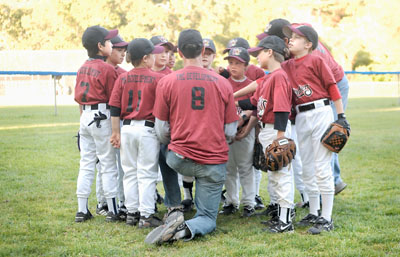
I spent a couple of hours at one game and made some fine actions shots, but couldn’t capture the moment I wanted between a coach and a player or a father and a son. I was looking for that instant, communicated visually, when knowledge moves from one generation to the next.

I returned a week later, this time to a night game and spent about an hour shooting before the game as the kids and dads warmed up, playing catch and a bit of pepper. As the light faded, I looked for some final shots. It would soon be too dark to shoot the game. Suddenly, the coach called all the boys near and he knelt before them. I has to change lenses and got off two frames before the huddle broke. The above frame image ran in the magazine.

Below is the essay I wrote to accompany the picture.

—————————————–

… And They Will Come

“Little League baseball is a good thing ‘cause it keeps the parents off the streets and it keeps the kids out of the house.” — Yogi Berra
Yogi Berra, the language-mangling New York Yankee, also once said, “You can observe a lot just by watching.”

What you observe when you watch the boys (and a few girls) take to local Little League diamonds is that this diminutive form of baseball depends as much on the coaching talents of fatherhood as the hitting and fielding skills of the sport.

Take a night game, for example. The fathers arrive fresh from work, some in their suits, others already changed into colorful T-shirts bearing the names of their children’s teams – Thunder, Storm or Raptors, outsized words for such pint-sized players.

Out come the gloves, the bats and the balls. A simple ritual begins. Catch. A child throws. A father catches. Back and forth. Back and forth. Encouragement is given, adjustments made. The moment is timeless, the lessons eternal.

As game time nears, the young players gather around their coach. He makes eye contact, commands attention. A man never seems so large as when he is surrounded by children who look up to him. A good coach, like Eric Dahlke of the Timber Rattlers in the Mill Valley Little League, takes a knee before his team, knowing that little ballplayers need men who are big enough to meet them at their level.

Grab Shots

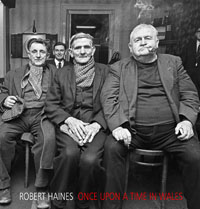
* Get Visual, Buy a Book: Here’s a good list of photo book publishers compiled by A Photo Editor. The cover on the left is from Once Upon a Time in Wales by photographer Robert Haines.
* Hope Amid the Flotsam: Another good read from A Photo Editor on the “endless stream of photography” and, with it, the proliferation of mediocrity. He connects through to a farewell post from photographer Liz Kuball in which she comments:

“It is so easy, when your Google Reader is always full of excellent photographs, to feel as though the rest of the world is producing constantly, consistently, at a level you’re simply incapable of.”

But cheer up, brave hearts, A Photo Editor also points to Magnum photographer David Alan Harvey’s more sanguine view:

“… but if you are “special” there are also way way more opportunities…and so so much room for invention….i swear, i have never seen so much room!!! “

* Get on the Grid: Sportsshooter Robert Hanashiro sings the praises of Dave Honl’s grids (and other gadgets) for speedlights. They work. I use them. Get some.

* Rumor Focus: Nikon Watch keeps the full-frame Nikon mill churning with word of 12mp D400 and a 24.8mp D3x.

* Sync & Swim: Check the Journey-to-the-Bottom-of-the-Sea rig Jill Greenberg used to shoot the U.S. synchronized swim team for a Radar magazine fashion spread.

Cartagena: Dancer

Cartagena Dancer
A wedding of two friends in Cartagena last week was a good excuse to end the vacation drought my wife and I have been in. We’d been working non-stop for about 18 months and whenever a getaway window opened we’d manage to slam it shut for one reason or another. So, when the couldn’t-say-no-because-we’d-help-bring-them-together invite to the boda in Colombia came, we jumped at the chance.

I couldn’t leave work behind completely, though, so I pitched a travel story to local magazine, packed a camera bag and booked a room in a luscious hotel fronting the Caribbean at a wedding rate that was 60 percent of rack.

Cartagena has hit the travel-writing radar lately. The New York Times just did a 36-hours-in-Cartagena piece, as did Travel & Leisure, which called it:

” … one of the prettiest cities anywhere: Imagine Havana with a fraction of the population, or San Juan or New Orleans without the sophomores on spring break. It’s both crumbling and majestic.”

I agree with all that, and would add that Cartagena is also home to some of the most beautiful human beings — women and men — I’ve ever seen. Skin colors range from the deep cocoas of the Afro-Caribbeans, to the mochas of the native South Americans, to the near ivory blanco of descendants the European pirates who pillaged the Colombian coast for centuries.

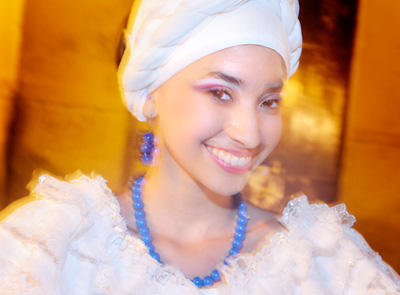
The dancer above was one of a troupe who accompanied the wedding party on its short walk back from the (blessedly air-conditioned) Iglesia Santo Toribio to the Sofitel Santa Clara Hotel. (The photo was shot with an SB800 on camera, using balanced TTL and rear-curtain shutter.)

The old-walled city of Cartagena was beautiful and a delight to photograph. The newer sections of town (where most people live) was a standard Latin America mix — flourishes of prosperity set amid wider pockets of poverty. The beaches were wide, the sand heavily tramped down (except on the outlying Islas del Rosario), and the water 80 degrees.

Fish fresh from the sea dominated menus — robalo, mero and, especially, pargo (red snapper). Street vendors fried up crunchy corn fritters called arepas, some filled with eggs, cheese and meat. Eating one was not an option.

Nothing, though, beat colder-than-cold limonadas, especially those made in a blender with lime juice, sugar, ice and club soda. Add in some leche de coco (coconut milk) and you get a concoction we gringos dubbed a Key Lime Pie.

On the Job: Run & Shoot

One of my great challenges in photography has been making new techniques work the first time out on the job. I haven’t always been successful at that, so if the job permits (meaning there’s enough time or the art director doesn’t have a specific shot in mind) I usually plan on a back-up shot as well, something I’m sure I can pull off.
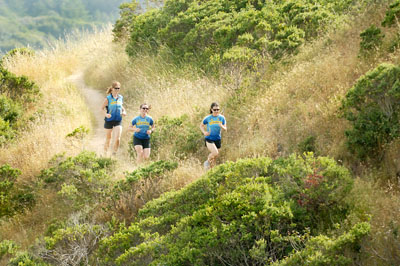
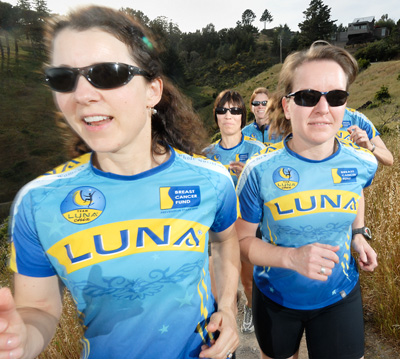
I shot the two pictures in this post to illustrate a story in Marin Magazine on trail running here in the Bay Area. The women belong to a Luna Chix running team headed by the magazine’s web mistress.

We chose a trail on Mt. Tam called the Sun Trail because it provided some great views (I wanted the context of the geography) and was close to a road (to cut down on the gear lugging.)

My original idea was to light three of the runners along a curve in the trail (like in the shot below), but after a few test shots I realized it would be very difficult to time the runners so a strobe hit each one as she passed. Also, I was shooting from 100 feet away on a rock out-cropping and would have needed an assistant to help reposition the lights after each test shot. Since this wasn’t a Chase Jarvis-type-budget-shoot, meaning it was just me and five runners, I went for Plan B.

First I shot three of the runners going through the curve. This was my sure shot. They were great sports because it was about 90 degrees out and they ran it a half-dozen times.

Then, I set up four SB800s along an upper portion of the trail — two in front and two along the side — and had them run toward me. When the led runner crossed a line I had made in the trail she shouted to me and I shot the group with a 12mm lens. I could only get off one frame each time since the flashes were firing on full power and needed recycle time, so the team ran it about 20 times. I did several variations of this shot, including backing way off with long lens.

The final shot (above) isn’t perfect, but it worked for the magazine and I learned a lot about lighting a group of moving people outdoors. Next time, I’ll concentrate more on separating each person, targeting them with an individual light and watching their expressions more.

The magazine used the above shot in the index and the below one as the lead shot for the story.

Luna Chix