On the Job: Marin Magazine Cover

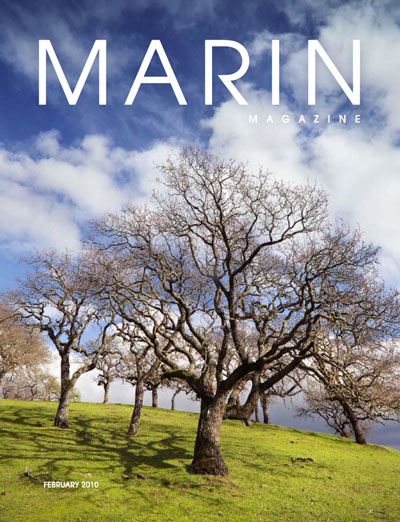
Marin Magazine February 2010 cover

Marin Magazine gave me a wonderful opportunity in the February issue — eight pages of photographs to illustrate the beauty of Marin County. To my surprise, the editor also chose one of the images for the cover — a grove of oak trees on a Novato hillside.

I made this photo quite by accident a year ago. I was looking for an elevated vantage point to photograph the Buck Institute’s distinctive I.M. Pei building as part of a story on Buck’s scientists.  As I climbed this little hillside with my gear, the sun suddenly came out from behind some storm clouds and lit up the grass and the trees. I shot about 10 frames before the cloud cover returned. Another shot from that moment is in the photo layout.

The text I wrote to accompany the pictures is below.

See all the photos in a slideshow. And, of course, they are available for purchase as fine art prints through the Marin Store.

—————————————————————–

Marin Views (text from magazine)

Much of my career, in photography and in journalism, has focused on people and their peccadilloes. They were rogues and rascals mostly, types you wouldn’t readily invite home for family dinner. Such was the business of news.

That changed when I began making pictures for Marin Magazine. Even though we have our share of local rapscallions, what captivated me as I ventured deeper into Marin than ever before were its various scapes—landscapes, seascapes, and, yes, bridgescapes. I was often out and about at first light or early evening, when nature presents its very best.

The beauty of this marvelous place filled me with wonder—the forested wilds of Tam, the windswept solitude of the beaches, the verdant promise of spring farmland, all of it connected, majestically, by a golden span to San Francisco.

–Tim Porter
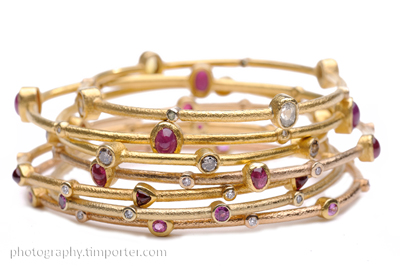
On the Job: Jewelry

Jewelry by Alix and Co.

Today and tomorrow I am shooting jewelry in the studio for the magazine. Even though I am happy to have the work–especially after the advertising disaster that was 2009–photographing jewelry is one of my least favorite things to do.

I do a pretty decent job with it– the above shot is of  bracelets from Alix and Co., Mill Valley jewelers–but there is still plenty for me to learn. There are nuances to the  lighting, especially to minimize unwanted reflections, I haven’t mastered, and I’d love to have a camera with perspective control into order to control depth of field more, but I’m not planning on buying a 4×5 any time soon.

I spent several hours in the studio yesterday working on new lighting set-ups, and even woke up last night about 3 a.m. thinking of another. This time, I am using more diffusers (including scrimming the whole shooting table) and more fill, and shooting on white plastic, which bounces the light very evenly. The quality of the light is the best I’ve made so far. Still, I have not figured out how to keep the camera from appearing in a reflection and continue to have difficulty controlling highlights while shooting on white.

Since I returned to photography five years ago–after a 20-year detour into newspapering–I have learned a great deal about the technical aspects of the craft, but acquiring the knowledge about shooting jewelry – or other tabletop products for that matter – is difficult for me because I don’t learn in a linear fashion. I am a sporadic learner, taking bits of know-how from here and there until I’ve put together a workable toolkit. Jewelry techniques, however, require certain amounts of exactitude and understanding of math and are best learned in a step-by-step manner, a method I have always found elusive.

At times like these, I wish I’d had the opportunity to apprentice with a commercial photographer and acquire some tricks of the trade from a master instead of picking them up piecemeal from books, the Internet and, of course, the lessons of past mistakes. But that is not the route my life took, and my photographic journey continues, one day at a time, one shot at a time.

I’ll let you know how it turns out.

Grab Shots: Afghanistan Photojournalism

Afghanistan soldier

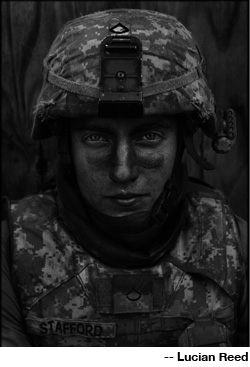
The battlefields change, the combatants differ, the technology improves, but some things about war remain constant: Soldiers are young, innocents die and photojournalists capture the carnage. Great human photography often emerges from terrible circumstances. Here are some examples from Afghanistan:

* The Long Haul: The Digital Journalist has a piece by photojournalist Lucian Reed about his life and work in Aftghanistan. It begins: “I’ve been to Afghanistan eight times in the last 18 months. My apartment is slowly taking on the look of a caravanserai. I have more friends in Kabul than Manhattan. My mind is full of snippets of Dari, counterinsurgency strategy and half-remembered warlords, major and minor. My son – not yet quite born – will have a Pashto middle name. I make no claims to being an expert on the place but, God knows, I seem to love it.”

* Field Test, Under Fire: Freelance photojournalist Danfung Dennis writes a technical piece on on DSLR News Shooter about using the still and video capabilities of the Canon 5DmkII in Afghanistan. He starts: “The 5D Mark II is capable of unprecedented image quality, but since it is a stills camera, there are several limitations that I had to address before using this camera in a warzone.”

* Getting Exisential in Afghanistan: Photojournalist Chris Hondros trails a platoon of GI’s on a hunt for Taliban caves. Stuck halfway up a hillside he ponders: “Why am I here? How did this happen? Why exactly am I hanging on the side of a mountain in Afghanistan this morning?  I’m not in Army, I didn’t sign up for this. I should be back home, watching TV or canoodling in bed or having a strong espresso in Brooklyn. Or just about anywhere else.” (In dscriber.)

* Gallery of War: Visit Battlespace, a powerful online gallery of images from Iraq and Afghanistan.

On the Job: Austin de Lone

Austin de Lone

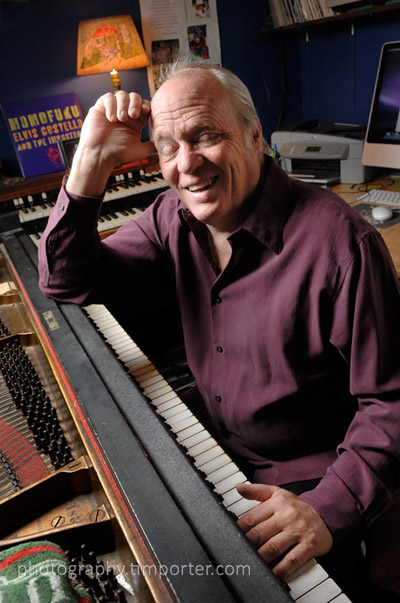
I love photographing artists and musicians where they work. Some have studios, some have garages, some have bedrooms in their homes that double as office, closet and creative space all crammed into a corner. And that’s where I found Austin de Lone, amid his keyboards and computer, wedged into a tiny spare bedroom in his Mill Valley home.

De Lone, known to fans and friends as Audie, is a former stage-mate of Elvis Costello and longtime Marin musician who sings and plays with his soul exposed and his heart wired to an amp. Marin Magazine was doing a profile of him in advance of a benefit he had put together to raise money to fight his young son’s rare illness, Prader-Willi syndrome.

Austin’s cramped studio was a joy to behold–perfectly, artistically cluttered–but also a challenge to shoot in. A grand piano not only dominated the room, but pretty much filled it. The instrument filled nearly one wall, and left only a narrow passage to walk through on the other side. Its top end abutted a closet and at the business end was just room enough for Austin to sit with a desk behind him. The room was also dark, little by only a 60-watt lamp.

In that cozy space, I needed a small light. I had brought along a small, 17-inch square softbox that fit over a Speedlight. I wanted to hang it from a boom over the piano, tight in on Austin so the light wouldn’t spread too much. There wasn’t enough room, though, to fully open a lightstand. I managed to get the legs of one half open,  hung three 15-pound sand bags over them and cranked the boom out over the piano with the light on the end. It wobbled precariously. I prayed to the stability gods and started shooting.

As you can see from the distortion, I was in close, a couple of feet away. I moved around as best I could, but Austin provided much of the action. He played a bit, hummed, sang a few bars, and told a story or two. All in good spirit.

In 20 minutes, I made several pictures I really liked. Austin was completely relaxed and at times seemingly unaware of me and my camera. I’ve seen other artists and musicians do the same in their studios. I think studios become extensions of their artists, a place where the hands and eye and the heart are indistinct from the tools–the keyboard or brush or computer. The studios and the artists meld, and there, even when creativity turns elusive  (as it so often does) they find their most comfort–and in that comfort good pictures can be made.

On the Job: Tim Hockenberry

Tim Hockenberry

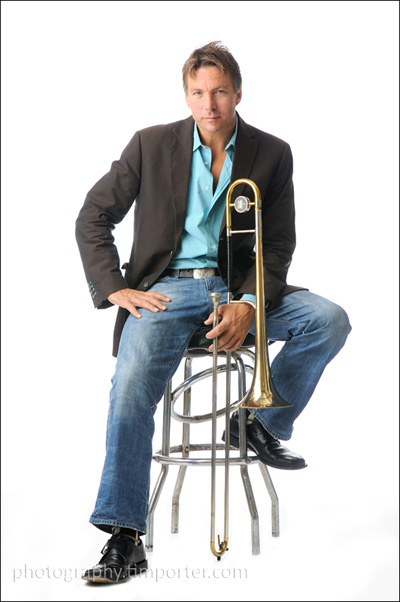
Tim Hockenberry, a Mill Valley singer and musician, is the kind of good-looking guy women notice — tall, stylish and, as my wife would say, twinkly. He caused quite a stir the day he came to my studio in San Rafael to do a shoot for Marin Magazine. One of my building-mates is a food stylist whose kitchen and studio is down the hallway from mine. She and a photographer were shooting hamburgers the day Tim arrived, and they had the door open when he passed by their studio from the elevator en route to my space.

After I got Tim settled in, I left him for minutes to chat with the writer and went down the hall to get something. The stylist called me in as soon as she saw me. “Who is that?” she said in a voice much spicier than the food she was styling. I told her. “Send him down here when you’re done.”

An hour, and several changes of clothes, later, Tim and I were done. We’d had a great time shooting — he was fun, engaging and knew how to pose, everything that makes my job easier. I made a variety of shots, including a batch with his trombone (his first instrument). For laughs — and much to the delight of the writer, a woman — we also shot a few shirtless ones as he changed clothes. I submitted about two dozen proof shots to the magazine, which ultimately used the one you see here and another in the table of contents. The shirtless photo didn’t make the cut, apparently, but later, on a visit to the magazine, there was a printout of it hanging above the desk of one of the writers.