On the Job: Marin Magazine Cover

The last couple of months I have been purposefully shooting landscapes with the goal of getting more covers on the magazine. This means I have been going out before first light in the morning or trying to catch the last light of the day, the proverbial golden hour.

The best light in the Bay Area happens during the winter, and that’s especially true here in Marin County, where the almost daily summer fog literally grays out the first morning light and can dull the evening light. Winter also brings rain clouds, something we don’t see in Northern California during our arid summers.

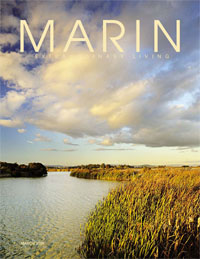
This picture was made in what may seem like an unlikely location — in a bayside marshland behind a sewage treatment plant. What the spot lacks in olfactory appeal, it more than makes up for in its marshes and wildlife. I have shot here several times and made some nice pictures, but nothing I considered having the necessary “grab” for a cover. When I saw this scene in mid-December on a day that had been showery, I knew I had found my moment.

Later, when I showed the editor of the magazine a half-dozen images — from this day and from other locations — she immediately went to this one. The final cover image was about a three-quarter crop from the original, with the art director taking some off the bottom. I had shot the original with the cover crop in mind.

Technical stuff: D3, 17-35mm lens, ISO 400, 1/160, F4, handheld.

Grab Shots: Annie Hocks Her Work

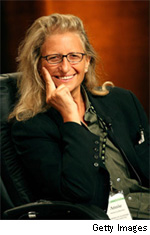
*Pawn My Photos: Annie Leibovitz has hocked all “copyrights … photographic negatives … contract rights” to work (past and future) as well as several pieces of real estate in exchange for a $15.5 million loan from a company called Art Capital Group, essentially an art pawn shop for the well-to-do. In other words, as the New York Times put it today, “one of the world’s most successful photographers essentially pawned every snap of the shutter she had made or will make until the loans are paid off.”

* Shooting Annie: Seattle photographer John Keatley talks with Feature Shoot about photographing Leibovitz: “I didn’t want to over think it, or get too worked up so far in advance. So I took a vacation to Mexico!”

* Making a Difference: Zack Arias produces a video for Scott Kelby in which he explores how to make his mark on “this massive matter of visual pollution we serve up every day.”

* Hot Shoe Diaries: That’s the title of Joe McNally’s new book on shooting with speedlights. Good stuff for those of use who don’t know everything. Pre-order it here.

* May I Shoot? No! Mary Ellen Mark talks about photographing Marlon Brando on the set of The Missouri Breaks. Brando’s rule, she tells LA Weekly, “was that set photographers must always ask permission before shooting him. Every time. And the answer was always no.” (Via A Photo Editor.)

Pobre Mexico

A few days ago the Wall Street Journal published a lengthy story about the ominous criminal, political and social conditions in Mexico that have combined to degrade civil society in many parts of the country to the brink of public disorder.

Fueling this collapse are two evils — the ravenous appetite of the narco cartels for control of the border, of law enforcement and of the proverbial hearts and minds of Mexico’s impoverished citizens; and the endemic, ubiquitous and persistent corruption of government on all levels.

The Journal piece focused on the implications for the United States should the rule of law fail in Mexico. It quoted a high-ranking official in the country’s current ruling party, the PAN:

“The Mexican state is in danger. We are not yet a failed state, but if we don’t take action soon, we will become one very soon.”

For me, it’s more personal. I have good friends — Mexicans and Americans — who live there. I have a house in Oaxaca, Mexico’s most beautiful state and also its poorest. I have seen the country’s working people, through resilient desire and endless effort, carve out good lives for themselves amid a system that favors the wealthy, the connected and the corrupt. And, sadly, I have witnessed well-off people I considered friends express disdain for the poor and for the creation of a society of laws. They are, after all, the beneficiaries of the current system.

I don’t cry easily. The scar tissue laid on during 20 years of daily journalism usually keeps the tears in check. But these days Mexico makes me cry.

In the fall of 2006 I stood in the zócalo, the main square, of Oaxaca – a place I love, where I got married, where I built a house on the far end of a dirt road – and watched a battered TV play a video of the day state police rousted striking public school teachers from the square. I watched the rise and fall of batons on makeshift shelters. I saw the march of heavy boots through darkened streets. Fires burned. Rocks flew. The camera shook. Above all, I heard the sound of helicopters, which police used to fling canisters of tear gas into the crowds below.

I cried right there as the video played. A woman next to me, dressed in the traditional apron of a southern Mexican housewife, saw me, an aging gringo journalist laden with camera gear, and said, “Que triste. Que triste.” How sad. How sad.

A few days later, local thugs — some say off-duty cops — opened fire on a protest march, killing freelance American journalist Brad Will. (Here’s a picture — not mine — of the shooting.)

The resulting international outrage — far beyond any that accompanied the earlier deaths of dozens of Oaxacans — prompted the federal government to send troops into the city restore order.

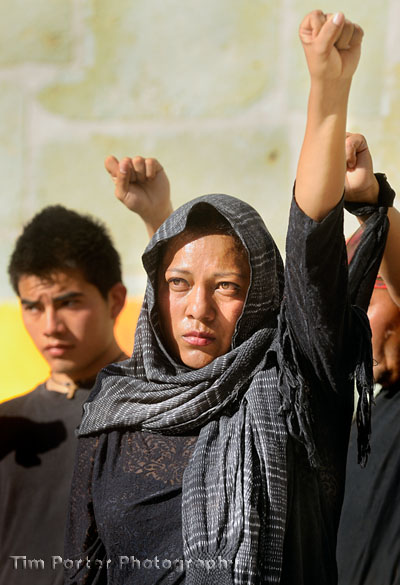
More than two years later, nothing has changed for the better in Oaxaca. The economy, highly dependent on tourism, has yet to recover. The governor who attacked the striking teachers remains in power. The leaders of the strike are jailed. The killers of Brad Will are free. (The photo at the top of the post is from an anniversary march in Oaxaca’s main square two years after the 2006 attacks.)

Multiply this one incident — a strike, a shooting, a disregard by the authorities for even the facade of justice — throughout the country and amplify it along the drug-trafficking lanes in the border cities and you begin to get grasp of the severity of the challenges Mexico faces. Here’s one fact: 6,000 people were killed in Mexico last year in drug-related violence. The U.S. dead in Iraq for six years of war is 4,200.

Perhaps you wonder why you should care about what happens in Mexico. After all, aren’t the beaches in Baja still beautiful and the pina coladas in Cancun just as tasty? De veras, they are. But Mexico is much more than an American playground.

First, it is also, as the Journal points out, the largest U.S. trading partner and with our economy already on life support we don’t need to lose our best customer.

Second, if you think having more than 4 million undocumented Mexican immigrants living in the United States is troublesome, then imagine the immigration pressure on the border should the Mexican government collapse. Says the Journal:

“It has 100 million people on the southern doorstep of the U.S., meaning any serious instability would flood the U.S. with refugees.”

Finally, there is morality. What is happening in Mexico is simply wrong. It is wrong to oppress the poor so the wealthy can prosper. It is wrong to deny people jobs because they belong to an opposing political party. It is wrong to glorify crime and drug use. And, it is wrong to kill journalists. (Read this report, or this one, or this one from the Committee to Protect Journalists.)

Poor Mexico. I cry for you. I wish I could do more.

Grab Shots: Old News Edition

* Newsies in the Pipeline: Newspapers are on life support, but J-school applicants are up in the U.K. and and in N.Y., reports Jarvis. Discuss.

* Readers Come, Money Doesn’t: Newspaper web readership is up 12% year over year (although web revenue is down). Nieman Journalism Lab lists its Top 15 newspaper sites. My hometown Chron (SFGate) averages 4.1 million uniques a month, up 10%. Somehow, there’s got to be a business in there.

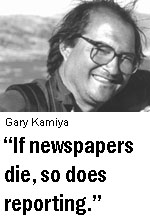
* Ready the Tombstones: Former S.F. Examiner colleague and Salon pioneer Gary Kamiya concludes: “If newspapers die, so does reporting.” And, in light of the web revenue report, he adds: “Currently there is no business model that makes online reporting financially viable.” (Mutter mines the same vein.)

* Cancel the Funeral: Steve Yelvington says he just has “to call bullshit on the “Newspapers Are Dead” meme. Some numbers:

“In spite of the worst economy since Roosevelt, many U.S. newspapers are still turning profits in the 15-20 percent range, and the U.S. newspaper industry is still turning around 50 billion dollars of gross revenue every year.”

* Cue the Elegy: that “show deep digging.” (Andrew Cline calls BS on him, saying: “Nostalgia is dead. It’s time to discover or create the next venue for journalism.”

Advice in a Storm

I have, to paraphrase Blanche Dubois, always benefited from the kindness of strangers. By this I mean I have had many guides — good people who, through advice, action or simply mannerism, provided me with a way forward when I could not see one and anchored me against the storms to which I have always been unwisely drawn.

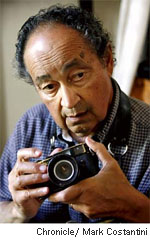
One of the most important of these people was Fran Ortiz, a photographer with the “old” San Francisco Examiner who taught me the principles of photojournalism at San Francisco State and, later, encouraged me to pursue a career in it. I took half of that advice — I kept the “journalism,” but dropped the “photo.” Now, I am trying to reunite them in some form.

Fran was a man of immense visual talent, but what made him such an accomplished photographer were his patience, gentility and humor, qualities that enabled him to insert himself (and his camera) into the lives of his subjects so seamlessly.
As a teacher, Fran was persistent in pushing us toward excellence. He taught me how to read a contact sheet to understand how I shot, how I moved through a scene or interacted with the person I was shooting. One frame, he would say, says little about the photographer. The entire shoot reveals his technique, personality, strengths and weaknesses. The same observations apply today on a screenful of images.

He told us to get closer, to move in, to be amid the action not apart from it, and to get in front of people — faces, not asses, he would say. These techniques were all part of Fran’s belief that, as Pulitzer Prize-winning photographer Kim Komenich said in this tribute: “Fran realized a photo should be made and not ‘taken.’ He based his entire way of seeing on the idea that the negative is the score and the print is the performance.”

Made not taken. I try to judge my own work by that standard and still fall far too short far too often.

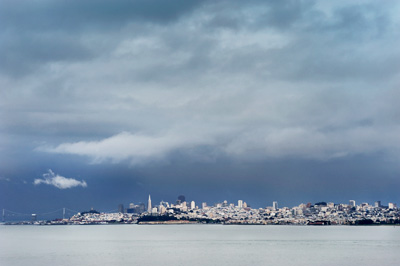
One of the best times to make pictures, Fran said, was in the worst of weather. When the weather gets bad, grab the camera and head out, he would tell us in class. During these last few days of heavy (and welcome) Northern California rain, I’ve heard Fran’s voice in my head quite often.

The shot above — San Francisco under a storm — is my response. I like it, but I keep wondering how Fran would tell me to improve it. (Take a bigger look.)

Grab Shots: Autumn and Annie

* Mystery Image Revealed: While doing some rainy day bookmark cleaning, I found this aging link from David Pogue of the Times about one man’s quest to find the origin of the Windows screensaver image you see at the left. Here’s the whole, hilarious story from writer Nick Tosches. One quote: “I see people in black hoods and robes sitting round a table, bound by blood oath never to divulge the latitude and longitude of Autumn.” Read on.

* Annie Works, We Watch: Annie Liebowitz photographs pairings of actors and directors for Vanity Fair. Here are the vids. Make sure to watch Mickey Rourke, then click to this Huffington Post collection of Rourke photos with him posing with one hand down his pants.

* Blogging Photog: A new entry on the blogroll is travel photographer Paul Souders. His blog is well worth the click. Here’s a takeout from an entry on shooting surfers in Costa Rica:

“I have never been much of a surf beach kind of guy. I grew up next to a chicken farm, a long way from any ocean. Plus I have issues with public nudity stemming from low self-esteem and a rigorous Lutheran upbringing.”

* Wayback Machine: Ever wondered what big city newspaper photographers looked like a couple of decades ago? Here’s the answer. The big guy on the left, Kim Komenich, won a Pulitzer; the pretty boy on the right, Kurt Rogers, is one of the founders of Think Tank Photo. All worked for the “old” San Francisco Examiner.

* Burning, Man: Magnum shooter David Alan Harvey has started Burn Magazine, an online platform for emerging photographers.

Grab Shots: Zelman, Reputation and a Duck

* Inside Bill Zelman: Strobist David Hobby does an interview with photographer Bill Zelman. Among other pearls he lays before us swine is this one: “Shooting good portraits is equal parts psychology, trust and technical expertise — with the technical part probably being the least important.” Read the whole interview. Check out the video as well.

*Wish You Were There? So, you couldn’t make to Joe McNally’s lastest lighting workshop, heh? No worries. Click here. Plenty of good photos and explanations of how they were made.

* Word of Mouth, Word of Mouth: That’s what Tom Miles, a 16-year commercial photographer in England, tells a college student is the secret to his success. He adds: “Doing a good job, being reliable and professional will get you more repeat work than any other method.”

* What the Duck, Man? Economy dragging on you? Editors treating you bad? Need a laugh? Go here.

* No Wimpy Photos: That’s the new mantra of Santa Rosa newspaper photographer John Burgess (and not a bad slogan for the whole newspaper industry). Here’s a result of that outlook — a portrait of Joel Peterson of Ravenswood Winery — and the story behind it.